Illinois Medicaid paid for 993,119 prescriptions for nine leading GLP-1 drugs between 2022 and 2025, at a gross cost of $1.1 billion. Every one was filled before November 9, 2026, when the FDA ordered manufacturers to add a warning about a rare form of permanent vision loss called NAION.
Table of Contents
Ankin Law analyzed four years of federal Medicaid prescription data to measure how widely these drugs are used in Illinois. In Illinois Medicaid, the most-prescribed GLP-1 drug is Trulicity, which has drawn far less attention than Ozempic.
Key Findings
- Annual prescriptions for these nine drugs in Illinois Medicaid rose 67%, from 172,652 in 2022 to 288,450 in 2025.
- Trulicity accounted for 178,820 prescriptions in 2025, about 6 in 10 of the total and nearly six times Ozempic’s count.
- About 99% of 2025 prescriptions were for diabetes-labeled drugs. Wegovy and Zepbound together made up 3,046.
- Prescriptions for tirzepatide (Mounjaro and Zepbound) climbed from 306 in 2022 to 36,372 in 2025, and Mounjaro passed Ozempic in 2025.
- Semaglutide prescriptions (Ozempic, Rybelsus and Wegovy) grew from 16,135 in 2022 to 55,327 in 2025.
“Most of the attention has gone to Ozempic, but the most-prescribed GLP-1 drug in Illinois Medicaid is Trulicity,” said Howard Ankin, founder of Ankin Law. “These are people managing diabetes, not chasing a trend. For years they filled these prescriptions without a word on the label about the risk of losing their sight. They deserved that information when they started treatment, not four years and nearly a million prescriptions later.”
Trulicity Is the Most-Prescribed GLP-1 in Illinois Medicaid
News coverage of GLP-1 vision loss has centered on Ozempic and Wegovy, but Illinois Medicaid prescriptions are dominated by Trulicity (dulaglutide), a once-weekly injection on the market since 2014. It was prescribed 178,820 times in 2025, compared with 30,556 for Ozempic.
Trulicity is among the 12 GLP-1 products covered by the FDA’s class-wide warning, a list that also includes Ozempic, Wegovy, Mounjaro, Zepbound, Rybelsus, Victoza and Saxenda. Patients who take Trulicity may assume the headlines about “Ozempic blindness” do not apply to them, but the FDA’s action covers their medication as well.
Trulicity use in Illinois Medicaid nearly doubled between 2022 and 2023, from 94,556 prescriptions to 183,752, and has stayed above 165,000 a year since.
The state’s own formulary likely explains the gap. Trulicity has been a preferred GLP-1 on the Illinois Medicaid Preferred Drug List in every version we reviewed, from January 2022 through July 2026. Injectable Ozempic was listed as non-preferred the entire time, and Mounjaro has been non-preferred since it first appeared on the list. Rybelsus is preferred only with prior authorization.
Nearly All of These Prescriptions Were for Diabetes Drugs
GLP-1 drugs are best known for weight loss, but Illinois Medicaid does not cover them for that purpose alone. As recently as July 2026, Wegovy, Zepbound and Saxenda were not on the state’s Preferred Drug List. Since October 1, 2026, the state has covered Wegovy and Zepbound only for specific conditions, such as cardiovascular risk and sleep apnea, with prior authorization.
Of the 288,450 prescriptions for leading GLP-1 drugs that Illinois Medicaid paid for in 2025, only 3,046 were for Wegovy or Zepbound, about 1%. The rest were for drugs approved to treat diabetes.
These are lower-income patients managing a chronic disease, often for years at a time. Many started treatment long before any vision warning appeared on the label.
Newer GLP-1 Drugs Are Climbing Fast
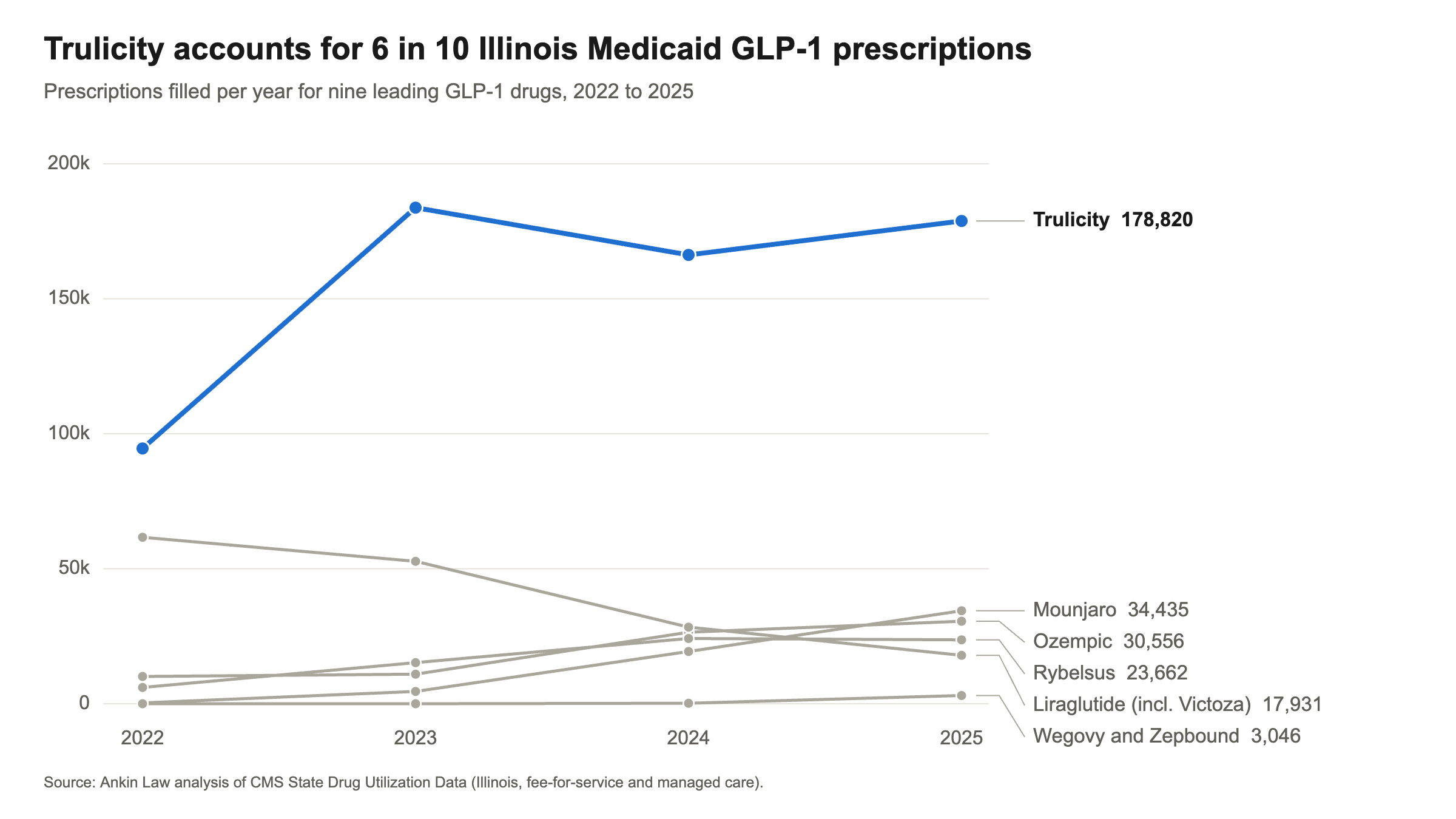
Trulicity has held a wide lead since 2023, but the mix beneath it is changing quickly. Mounjaro went from 306 prescriptions in 2022 to 34,435 in 2025 and overtook Ozempic along the way. Ozempic roughly tripled over the same period.
Victoza moved in the opposite direction, falling from 61,655 prescriptions in 2022 to 1,417 in 2025 as generic liraglutide became available. Every drug on this chart belongs to the class covered by the FDA’s November 2026 warning.
What the Data Does Not Show
These figures measure how widely GLP-1 drugs are used in Illinois. They do not measure how many people have been harmed, and they come with several limits.
- These are prescription counts, and one patient who refills monthly accounts for about 12 a year. The number of individual patients is far smaller.
- NAION is rare: the FDA’s review found roughly 6.4 cases per 100,000 patient-years among GLP-1 users, compared with about 3.8 among people on a placebo or other glucose-lowering drugs. Most people who take these medications will never develop it. Our overview of the FDA warning explains the findings in detail.
- The data covers Medicaid only and excludes private insurance, Medicare and patients who pay cash. Nationally, about 12% of adults report currently taking a GLP-1 drug, according to KFF polling, so total Illinois use is much higher.
- Dollar figures are gross, before manufacturer rebates, so the state’s net cost is lower.
Anyone taking a GLP-1 medication who notices sudden vision loss, especially in one eye, should seek medical care right away. Patients should not stop a prescribed medication without talking to their doctor.
Europe Flagged the Vision Risk 17 Months Before the FDA
For four years, Illinois patients filled close to a million prescriptions for leading GLP-1 drugs with no mention of NAION on the label. On June 6, 2025, the European Medicines Agency’s safety committee concluded that NAION is a very rare side effect of semaglutide and recommended adding it to the product information for Ozempic, Rybelsus and Wegovy. The FDA required a U.S. warning 17 months later.
That gap is central to the lawsuits now pending against GLP-1 manufacturers. Federal vision loss claims have been consolidated in MDL No. 3163 in the Eastern District of Pennsylvania before Judge Karen Marston. The cases allege that manufacturers failed to adequately warn patients and doctors about the risk.
A NAION diagnosis alone does not establish that a drug caused it or that a manufacturer is liable. Each claim depends on the medical evidence, the timing of the prescription and what warnings the patient received.
Ankin Law is investigating GLP-1 vision loss claims for Illinois patients. If you or a family member lost vision after taking one of these medications, call 312-600-0000 for a free consultation.
Methodology
Ankin Law analyzed the Centers for Medicare & Medicaid Services State Drug Utilization Data files for 2022, 2023, 2024 and 2025, as updated by CMS in July 2026. The data was retrieved on November 13, 2026.
Download the data (CSV): all 832 Illinois records used in this analysis, by drug, package code, quarter and program type.
- Scope: all records with state = Illinois, combining fee-for-service and managed care.
- Drugs included: nine leading GLP-1 products, matched by product name: Ozempic, Wegovy, Rybelsus, Mounjaro, Zepbound, Trulicity, Victoza, Saxenda and generic liraglutide. Exenatide, Xultophy, Soliqua and Foundayo are also covered by the FDA’s warning but were not analyzed, so class-wide totals are higher.
- Suppressed records: CMS withholds any drug-package record with fewer than 11 prescriptions. Those records are excluded from the totals, so true totals are slightly higher. Saxenda was suppressed in every quarter and shows no reportable prescriptions.
- Spending: total amount reimbursed, before rebates.
- 2026: excluded, because only a partial first quarter was available.
Generic liraglutide is included because the FDA’s requirement applies to all GLP-1 receptor agonist medications, and liraglutide is among the listed active ingredients. Excluding generic liraglutide, the four-year total is 974,120 prescriptions.
Illinois Medicaid GLP-1 Prescriptions by Drug and Year
| Drug | 2022 | 2023 | 2024 | 2025 |
|---|---|---|---|---|
| Trulicity | 94,556 | 183,752 | 166,245 | 178,820 |
| Mounjaro | 306 | 4,551 | 19,346 | 34,435 |
| Ozempic | 10,102 | 10,945 | 26,484 | 30,556 |
| Rybelsus | 6,033 | 15,224 | 24,171 | 23,662 |
| Liraglutide (generic) | 0 | 0 | 2,485 | 16,514 |
| Victoza | 61,655 | 52,750 | 25,886 | 1,417 |
| Zepbound | 0 | 0 | 0 | 1,937 |
| Wegovy | 0 | 0 | 178 | 1,109 |
| Total prescriptions | 172,652 | 267,222 | 264,795 | 288,450 |
| Gross spending | $208.8M | $297.0M | $291.1M | $305.5M |
Four-year totals: 993,119 prescriptions and $1.10 billion in gross spending.