


Chicago Truck Accident Lawyers
After a crash, trucking companies move fast to protect themselves. You should too.
If you don’t have an experienced truck accident lawyer to protect your rights, you could end up paying for medical bills, lost wages, and the fallout from someone else’s negligence.
At Ankin Law, we take these cases seriously. We push back when insurance companies try to minimize what you’ve been through.
- Our lawyers have a 98% success rate in serious injury cases
- We have more than 100 years of combined experience
- We’re available 24/7
- We offer FREE consultations
- If you can’t come to us, our attorneys will come to you
“The details matter in truck accident cases. The records, the timing, the decisions that were made before the crash. That’s what tells the true story.”
~ Howard Ankin

Hundreds of Millions Recovered for Our Clients
These results come from complex injury cases we’ve handled where liability was contested, and the stakes were high. We pursue full compensation when serious harm has been caused.
Table of Contents
What Makes Truck Accident Cases Different
Truck accident cases are not handled the same way as standard car accident claims.
After a crash with an 18-wheeler, you are often left dealing with a commercial operation, not just a driver. That means company policies, federal safety regulations, maintenance records, and driver logs may all come into play. It also means the insurance coverage is larger, and the defense is more aggressive.
In many cases, the trucking company begins investigating the crash immediately. Their goal is to limit liability and control the narrative before a claim is fully developed.
These cases require a different approach from most other types of personal injury cases. Identifying all responsible parties, preserving key evidence, and understanding how trucking regulations apply can make a significant difference in the outcome.
Why Truck Accidents Happen in Illinois
Truck accidents are usually preventable. They happen when drivers, companies, or other parties fail to follow basic safety standards.
Common contributing factors include:
- Driver fatigue from long hours and tight delivery schedules
- Distracted driving, including phones and in-cab systems
- Speeding or aggressive driving to meet deadlines
- Improper maintenance, including brakes and tires
- Overloaded or improperly secured cargo
- Failure to follow federal hours-of-service regulations
In many cases, the issue is not just driver error. It is pressure from the company, lack of oversight, or failure to maintain equipment properly.
- Motor Vehicle Accidents
- Car Accident Lawyer
- Airplane Accident Lawyer
- Bicycle Accident Lawyer
- Boat Accident Lawyer
- Bus Accident Lawyer
- Chicago Sideswipe Car Accident Lawyer
- Chicago Multi-Vehicle Accident Lawyer
- Cicero Car Accident Lawyer
- Cruise Ship Accident Lawyer
- Distracted Driving Accident Lawyer
- Drunk Driving Accident Lawyer
- Evanston Car Accident Lawyer
- Fatal Car Accident Lawyer
- Head-On Collision Accident Attorney
- Helicopter Crash Lawyer
- Highway Accident Lawyer
- Hit and Run Lawyer
- Hyde Park Car Accident Lawyer
- Motorcycle Accident Lawyer
- Oak Lawn Car Accident Lawyer
- Parking Lot Accident Lawyer
- Pedestrian Accident Attorney
- Rear-End Accident Lawyer
- Rental Car Lawyer
- Rollover Car Accident Lawyer
- Skokie Car Accident Lawyer
- T-Bone Accident Lawyer
- Train Accident Lawyer
- Truck Accident Lawyer
- Uber Accident Attorney
- Uninsured Motorist Lawyer
Center:

Injured by a medical provider? Check out our medical malpractice knowledge center to learn more about medical malpractice cases.
Truck Accidents in Chicago: Where They Happen
Truck accidents in Chicago are not random. They tend to happen in the same high-traffic corridors where congestion, tight lanes, and constant freight movement collide.
We regularly see serious crashes on and around:
- I-90 / I-94 (Kennedy and Dan Ryan Expressways)
- I-290 (Eisenhower Expressway)
- I-55 (Stevenson Expressway)
- I-80 and I-294 near major freight routes
- Lake Shore Drive, especially where traffic compresses and merges
- Industrial corridors on the South Side and near Cicero, Pulaski, and Ashland
These are not easy roads to navigate, even for experienced drivers. For truck drivers operating large commercial vehicles, the margin for error is even smaller.
Traffic stops fast. Lanes shift in construction zones. Drivers cut in and out trying to make exits. A fully loaded truck cannot respond the same way a passenger vehicle can. It takes longer to stop, requires more space to turn, and has significant blind spots.
We also see crashes happen when trucks leave expressways and enter tighter city streets. Wide turns, delivery routes, and limited visibility create situations where smaller vehicles, cyclists, and pedestrians are put at risk.
In many of these cases, the issue is not just the road. It is how the truck is being operated on that road. Speed, fatigue, poor judgment, or pressure to stay on schedule can turn already difficult driving conditions into serious accidents.
When a crash happens in these environments, the injuries are often severe and the liability is rarely simple.
Common Types of Truck Accidents
Truck accidents happen in specific ways, often tied to how these vehicles operate on busy roads like I-90/94, I-55, and city intersections throughout Chicago.
Some of the most common include:
- Jackknife accidents
The trailer swings out and forms an angle with the cab. This often happens during sudden braking or loss of traction, especially in heavy traffic or poor weather. - Rollover accidents
Trucks can tip due to high speeds, sharp turns, or uneven cargo. These crashes are more likely on ramps, curves, and exit lanes. - Underride and sideswipe accidents
These often occur in blind spots or during lane changes. Smaller vehicles can be pushed off the road or pulled under the trailer. - Rear-end collisions
Trucks require more distance to stop. In stop-and-go traffic, especially on expressways, this can lead to high-impact crashes. - Wide-turn accidents
Trucks need extra space to turn, particularly at city intersections. Other drivers may misjudge the movement and get caught alongside the trailer.
Each type of accident raises different questions about fault, vehicle operation, and driver decision-making.
Evidence That Can Make or Break a Truck Accident Case
In a Chicago truck accident case, evidence drives everything. These are not claims you can prove with a police report alone. Most of the key evidence is in the hands of the trucking company, and some of it does not last long.
Many commercial trucks traveling through Chicago, especially on I-90/94, I-55, and I-294, are equipped with systems that track how the truck was being driven before the crash. That data can show what really happened.
Key Evidence in a Truck Accident Case
- Electronic logging device (ELD) data showing driving hours and rest periods
- Black box data capturing speed, braking, and impact details
- Driver logs and dispatch records showing routes and deadlines
- Maintenance and inspection records for brakes, tires, and other systems
- Cargo records showing how the load was secured
- Traffic camera or surveillance footage from nearby buildings or intersections
Timing Matters
- Electronic data can be overwritten
- Video footage can be deleted
- Company records can become harder to obtain
Who Is Liable in a Truck Accident?
Liability in a truck accident is not always straightforward.
Unlike a typical car crash, there may be multiple parties involved. Each one may try to shift blame to avoid paying for the damage.
Identifying who is responsible is one of the most important parts of a truck accident case.
The Truck Driver
The driver may be responsible if the crash was caused by:
- Speeding
- Distracted driving
- Fatigue
- Driving under the influence
- Failing to follow traffic laws
In Chicago traffic, even a moment of inattention on roads like I-90/94 or I-290 can lead to a serious crash.
The Trucking Company
The company may be liable if its actions contributed to the crash.
This can include:
- Hiring unqualified drivers
- Failing to properly train drivers
- Pushing unrealistic delivery schedules
- Ignoring hours-of-service rules
- Skipping maintenance or inspections
In some cases, the issue is not just what the driver did. It is what the company allowed or encouraged.
Cargo Loading Companies
If the truck was improperly loaded, the company responsible for the cargo may be liable.
This can happen when:
- The load is unbalanced
- Cargo shifts during transport
- The truck is overloaded
- Materials are not properly secured
Improper loading can lead to rollovers, jackknife accidents, and loss of control.
Manufacturers
If a defective part contributed to the crash, the manufacturer may be liable.
In some cases, the issue may involve a design defect, a manufacturing defect, or a failure to warn about known risks. Examples include:
- Brake system failures that prevent the truck from stopping properly
- Tire defects that lead to blowouts at highway speeds
- Steering component failures that affect control of the vehicle
- Trailer connection or coupling issues that cause detachment
If the failure traces back to the manufacturer, they may be held responsible.
Maintenance and Repair Providers
Some trucking companies rely on third parties to inspect and maintain their vehicles.
These providers may be liable if poor maintenance contributed to the crash, including:
- Brake failures
- Worn or defective tires
- Faulty lights or signals
- Steering or suspension issues
- Failure to identify or fix known mechanical problems
When a truck is not properly maintained, the risk of a serious accident increases. If a maintenance provider failed to do the job correctly, they may be part of the case.
Why Liability Matters After a Semi Crash
Identifying every responsible party affects how much compensation may be available.
Truck accident cases often involve larger insurance policies, but those policies are also heavily defended. If one party is missed, it can limit what you are able to recover.
That is why these cases require a careful and thorough investigation from the start.
How Much Is My Truck Accident Lawsuit Worth?
The value of a truck accident case depends on how the injury has affected your life. More serious injuries usually lead to higher claims because they require more treatment, longer recovery, and may impact your ability to work. Types of damages include:
Economic Damages
These are the direct financial losses caused by the accident. They are typically supported by bills, records, and documentation.
Examples include:
- Medical expenses, including hospital stays, surgery, and follow-up care
- Ongoing treatment, rehabilitation, and therapy
- Lost wages from time missed at work
- Reduced earning capacity if you cannot return to the same job
- Out-of-pocket expenses related to your injury
Non-Economic Damages
These damages reflect how the injury has affected your daily life. They do not come with receipts, but they are still real and significant.
Examples include:
- Pain and suffering
- Loss of normal life
- Emotional distress
- Disability or disfigurement
- Loss of companionship or support for family members
When Punitive Damages May Apply
In some cases, additional damages may be awarded.
Punitive damages are not meant to compensate for losses. They are meant to punish especially reckless or dangerous behavior.
This may apply in situations involving:
- Driving under the influence
- Extreme safety violations
- Egregious negligence by a trucking company
These damages are less common, but they can significantly increase the value of a case when they apply.
What To Do After a Truck Accident
In the days and weeks after a truck accident, what you do can affect both your recovery and your ability to pursue a claim. This is when the case starts to take shape.
Continue Medical Treatment
Follow through with all recommended care.
- Attend follow-up appointments
- Follow treatment plans
- Keep records of diagnoses, medications, and procedures
Gaps in treatment can be used against you. Consistent care also creates a clear record of your injuries.
Keep Records of Expenses and Losses
Save documentation related to the accident.
This may include:.
- Medical bills and receipts
- Insurance statements
- Wage loss or reduced hours
- Out-of-pocket costs related to your injury
These records are used to calculate the value of your claim.
Avoid Discussing the Accident Publicly
What you say outside your claim can still be used against you.
This includes:
- Social media posts
- Messages about the accident or your injuries
- Photos or updates that can be misinterpreted
Even casual posts can create issues later.
Document How the Injury Affects Your Life
Truck accident injuries often impact more than just your health. Keep track of:
- Time missed from work
- Physical limitations or pain
- Changes to daily activities
- Ongoing symptoms
This helps show the full impact of the injury over time.
Be Careful With Insurance Companies
You may be contacted by insurance adjusters after the crash.
Keep in mind:
- They may ask for recorded statements
- They may request access to your medical records
- Early settlement offers are often lower than the full value of a claim
Be cautious about what you say and what you agree to before understanding your options.
Speak With a Truck Accident Lawyer
Truck accident cases involve more than just insurance claims.
A lawyer can help:
- Identify all responsible parties
- Preserve important evidence
- Handle communication with insurers
- Evaluate the full value of your claim
Taking this step early can help you avoid mistakes that are difficult to fix later.
Client Testimonial

A friend of mine referred me to Ankin Law, so I called for a consultation. I spoke with Kenny Jackson and right off the bat he was very professional yet easy to talk to, and he made me confident that he really cared about my insurance issue. Kenny was also very knowledgeable and after explaining everything about my insurance dispute he was able to phrase the legal terminology in a way I could understand and made me realize I did not actually have a case. That being said, I will definitely be calling Kenny back if I need any legal help and I will tell all my friends and family the same, “call Ankin Law and ask for Kenny” and you will be confident that you will be taken care of by the best!
I had been recommended this law firm to help with several of my legal issues. The person that helped me, Vivian, was very accommodating and answered all the questions I had. At first I was nervous because I never had any experience dealing with legality issues. However, Vivian made sure that the process went smooth and I left with confidence. Highly recommend.
I had the distinct pleasure of working with Chris Garrett on my legal case a while back. Thankfully he was able to break down the complex language and systems within the legal system. He was able to empathize with me and make this a personal experience. I did not just feel like a number to him. I felt like a real person that he and his team cared about. I am happy with the result of my case and look forward to referring not only Ankin Law but specifically Chris Garrett in the future.

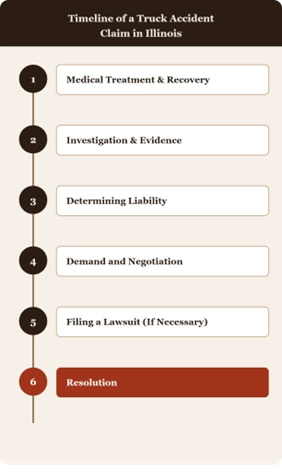
Timeline of a Truck Accident Claim in Illinois
Truck accident cases do not resolve overnight. Most claims follow a general timeline, and understanding the process can help you know what to expect.
1. Medical Treatment and Initial Recovery
Immediately after the crash and in the weeks that follow, the focus is on medical care and documenting injuries.
2. Investigation and Evidence Collection
Records are gathered, including police reports, medical records, electronic data, and witness statements. This is when key evidence is preserved.
3. Determining Liability
The facts are analyzed to identify all responsible parties, which may include the driver, trucking company, or others.
4. Demand and Negotiation
A claim is presented to the insurance company. Negotiations may follow based on the strength of the evidence and the extent of the damages.
5. Filing a Lawsuit (If Necessary)
If a fair resolution is not reached, the case may proceed to litigation.
6. Resolution
The case may settle or proceed through the court process to a final outcome.
Frequently Asked Questions About Truck Accident Cases
How long after a truck accident can I file a claim?
In Illinois, most personal injury claims must be filed within two years of the accident. However, waiting too long can make it harder to gather evidence and build a strong case.
What if the truck driver says the accident was my fault?
Fault is not determined by what a driver says at the scene. It is based on evidence, including reports, data, and witness accounts. In many truck accident cases, liability is disputed.
Will the trucking company contact me after the crash?
It is common for insurance representatives to reach out. They may ask for statements or offer early settlements. These offers are often made before the full extent of injuries and damages is known.
What makes truck accident cases harder than other injury claims?
These cases often involve multiple parties, federal regulations, and technical evidence. The insurance coverage is typically larger, and the defense is more aggressive.
Do all truck accident cases go to court?
No. Many cases are resolved through settlement. However, some require litigation if a fair agreement cannot be reached.