A 2026 toy safety report by the US PIRG Education Fund has brought to light the dangers of many children’s products that have hit the shelves ahead of the holiday season. From January through July of this year alone, the CPSC has issued more than 900 notices of shipment violations regarding toys. Shipments often contain hundreds or even thousands of the affected products.
Table of Contents

With various holidays centered around gift-giving this time of year, parents are searching stores and online marketplaces for gifts that will bring joy to their children. But what happens when a well-intentioned purchase puts a dangerous product into a child’s hands?
If a dangerous toy injured your child, you deserve answers. Our attorneys will help you understand your legal options and pursue accountability from those responsible.
Call 312-600-0000 for Ankin Law.
Key Takeaways
- The 2026 toy safety report identifies concerns involving choking hazards, burns, recalled toys, and AI-powered toys.
- According to the CPSC, an estimated 183,300 toy-related emergency room injuries involved children ages 14 and younger in 2025.
- Parents can check the CPSC recall database before purchasing toys. If a defective toy injures their child, they may have grounds for a product liability claim.
How Many Children Are Injured by Toys Each Year?
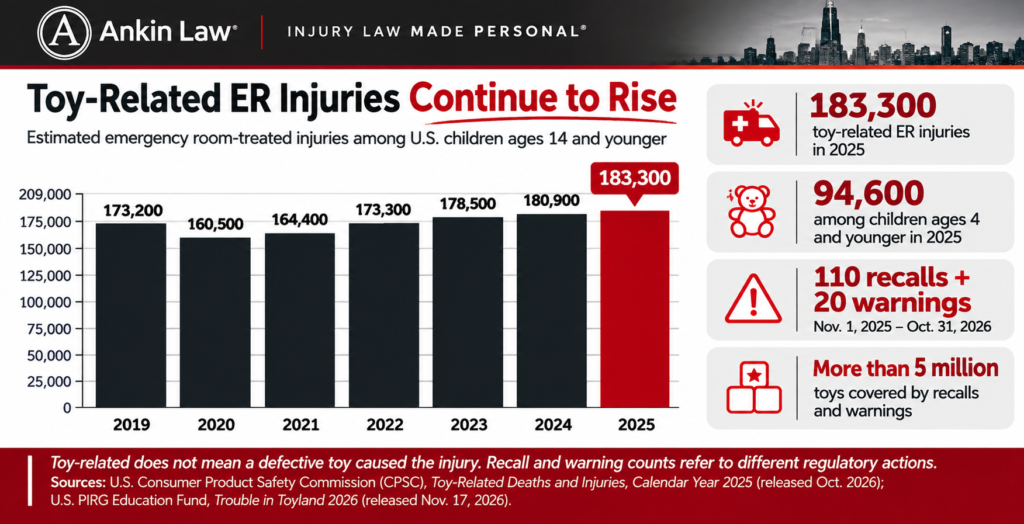
Toy-related injuries continue to send thousands of children to emergency rooms across the United States. According to the U.S. Consumer Product Safety Commission (CPSC), an estimated 183,300 children ages 14 and younger received emergency room treatment for toy-related injuries in 2025, compared to 160,500 in 2020.
Young children are particularly vulnerable. In 2025, approximately 94,600 toy-related emergency room injuries involved children ages 4 and younger, accounting for more than half of the estimated injuries among children 14 and younger.
The following infographic illustrates toy-related injury trends from 2019 through 2025, along with findings about recalls and safety warnings highlighted in the 2026 Trouble in Toyland report.
Not every toy-related injury involves a defective product. Some injuries result from improper use, age-inappropriate toys, or other circumstances. However, toys with dangerous designs, manufacturing defects, or inadequate safety warnings can expose children to preventable risks.
With the holiday shopping season underway, these statistics underscore why parents should pay attention to product recalls, safety warnings, and potential hazards before purchasing toys for their children.
What Dangerous Toys Did the 2026 Report Identify?
The 2026 Trouble in Toyland report identifies several types of toys that may pose risks to children, including squishy toys, infant activity toys, and AI-powered talking “buddies”. Some present physical dangers, such as choking and burn hazards, while others raise concerns about inappropriate content and dangerous instructions.
Squishy toys: Some squishy toys contain water beads that can expand if swallowed, potentially causing intestinal blockages. The CPSC has also warned about children heating squishy toys as part of a social media trend. When these toys burst, hot gel can cause burns.
Infant activity toys: Certain pull-string activity and teething toys have been recalled or identified in safety warnings because their silicone strings exceed permitted lengths and pose choking hazards. According to the report, nearly half a million of these toys were affected by recalls or warnings during the preceding year.
AI-powered toys: Researchers testing seven AI-powered toys found that some provided inappropriate responses or instructions involving dangerous household objects. Although these concerns differ from physical product defects, they highlight emerging safety questions about children’s toys.
| Toy category | Reported concern | Hazard | Parent action |
| Squishy toys | Hidden water beads or heated gel | Swallowing hazard or burns | Check age guidance; inspect toy construction |
| Infant string toys | Long strings on infant activity toys | Entanglement or choking | Follow age labels and CPSC warnings |
| Recalled/counterfeit toys | Unsafe items appearing in online listings | Varies by product defect | Verify seller and check CPSC recalls |
| AI-powered toys | Inappropriate or unsafe generated responses | Safety and behavioral concern; not necessarily a defect injury | Review features, parental controls and privacy |
The report also identified 110 toy recalls and 20 CPSC safety warnings between November 1, 2025, and October 31, 2026. Together, these actions involved more than 5 million toys, underscoring the importance of checking product safety information before making holiday purchases.
Why Can Unsafe Toys Still Be Found Online?
Online marketplaces often feature products from third-party sellers, making it difficult to determine whether every item meets applicable safety standards. Some sellers may offer counterfeit toys or products that have not undergone appropriate safety testing. As a result, dangerous or defective toys can still find their way into the hands of unsuspecting consumers.
Can a Manufacturer Be Liable If a Defective Toy Injures a Child?
A manufacturer may be held liable when children are injured by defective toys if the product’s defect can be directly linked to the product’s design, manufacturing defects, or inadequate safety warnings. Parents must generally establish that the toy in question was unreasonably dangerous or defective, and that their child was harmed as a direct result of this issue. Depending on the circumstances, other parties involved in distributing or selling the product may also be held responsible.
Does an Official Recall or Safety Warning Establish Liability?
No. An official product recall or safety warning does not automatically establish manufacturer liability. Parents must be able to prove that the toy was defective or unreasonably dangerous and that the defect caused their child’s injuries. A recall or warning may provide useful information when investigating a potential product liability claim, but the specific circumstances of the injury still matter.
Understanding who to hold liable for dangerous and defective children’s toys is an important part of pursuing a product liability claim. When we take your case, an experienced product liability attorney at Ankin Law will investigate what caused your child’s injury and identify who can be held liable.
How Can Parents Check Whether a Toy Has Been Recalled?
Parents who are concerned their child may have a toy that has been recalled can check the CPSC recalls page. The website allows you to search for a specific product and check if there have been any recalls associated with it. Additionally, there is a Product Safety Warnings tab for products that have been identified as unsafe but have not been officially recalled.
Make sure to double check that your child’s toy is part of the recall. Not every model or production lot may be affected, even when products appear identical. Depending on the product, you can find information such as lot numbers, model numbers, and other identifying information on either the product itself or its packaging. The official recall notice, which can be found on the CPSC website or the company’s official website, will have information identifying which products are recalled and how to tell if your product is affected.
Always follow official recall instructions. Do not try to repair or remedy the defect yourself unless the notice instructs you to do so.
What Should Parents Do If a Child Is Injured by a Toy?
If a defective toy caused injury to your child, seek immediate medical attention. Document everything you can, such as pictures of the product and its defect, purchase receipts, and medical records detailing your child’s injuries and the treatment necessary for their recovery. Also document the resulting medical expenses.
Preserve the toy, its packaging, and any broken pieces. Avoid repairing, altering, or discarding the product, as it may be important evidence in a potential product liability claim.
Monitor your child for symptoms of further complications relating to the incident, and contact the appropriate manufacturer or regulator of the product. You can also report an unsafe product to the CPSC.
Ankin Law Helps Families Recover
Ankin Law has years of experience handling product liability claims involving dangerous and defective products. Our attorneys can investigate the circumstances of your child’s injury, identify potentially responsible parties, and build a case to pursue compensation for your family’s losses.
If your child was injured by a defective toy, you have options. Contact Ankin Law for a free consultation. Call 312-600-0000 to learn how our attorneys can help you pursue compensation for your child’s injuries.